What do we mean when we talk about product labeling?
בהתאם להוראות חוק שונות יש חובות שונות של סימון מוצרים. לדוגמה: אם מוצרים מיובאים לישראל מחו"ל ישנה חובה לתרגם מידע שמופיע על גבי האריזה.
If the product comes with an instruction manual, it is mandatory to translate the instruction manual into Hebrew, all so that the consumer in Israel will not have difficulty understanding how to use the product he purchased.
In terms of the provisions of the law and the damage caused to the consumer, there may be a difference between a situation in which No product labeling is performed at all. and incorrect product labeling. This issue may have implications for the ability to submit Request for approval of a class action lawsuit Or the amount of compensation that may be awarded in a class action proceeding.
When considering a class action lawsuit regarding product labeling, you also need to understand the scope of the violation. The smaller the violation (for example, a business that sells tens of thousands of products and has not labeled a few products), the less likely the court will approve a class action lawsuit.
On the other hand, there may be only one product among tens of thousands of products that the business sells, but it is a highly sought-after product that is sold to hundreds of thousands of customers, and it was not properly labeled. In such a situation, there may be good grounds to conduct a class action lawsuit for failure to label specific products (but the group will need to be defined so that it only refers to customers relevant to that product or a small group of products).

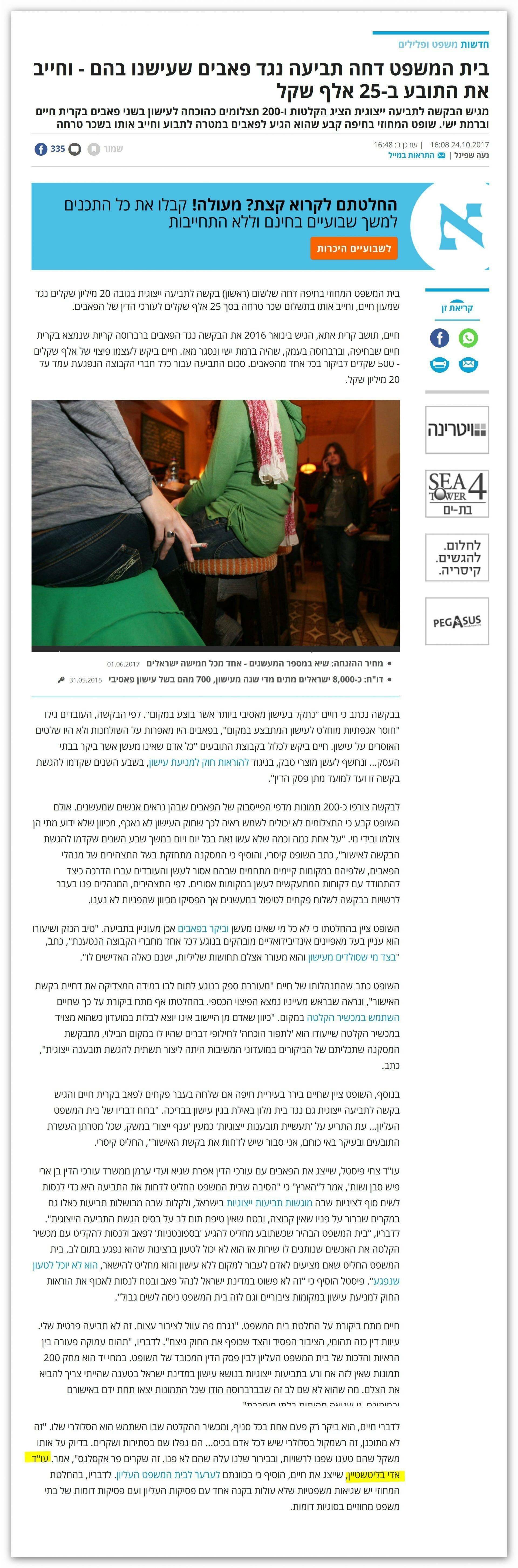
Ruling that rejected a request to certify a class action lawsuit regarding product labeling
In recent years, more and more cases have been identified in which the courts are not in a hurry to approve class actions regarding product labeling, especially if the claimant did not first contact the respondent through a prior request before filing the class action.
דוגמה לכך ניתן למצוא במסגרת ת"צ 46208-05-25 שרה ברק נ' פי. אס. די. אס יזמות בע"מ, שם נקבע, בין היתר, כך:
The request for approval alleged that the respondent was violating the obligations set forth in the law regarding labeling and attaching instructions in Hebrew to imported products. The applicant detailed in the request for approval seven cases in which she purchased – herself or through members of her family – various products from the respondent, and in each of which, she claimed, various legal provisions were violated. The violations to which the request for approval refers (not all of which were committed, as alleged, in each of the products) are: failure to label the manufacturer's name and address in Hebrew; and failure to translate instructions for use and warnings into Hebrew.
…
ההפרות הנטענות ביחס למוצרים הן משני סוגים: (א) אי תרגום הוראות שימוש ואזהרה לעברית, בניגוד לחובה הקבועה בסעיף 2(ו) לצו הגנת הצרכן (סימון טובין), תשמ"ג-1983 (להלן: Goods marking order), הקובעת כי "על טובין מיובאים עם הוראות שימוש או אזהרה בלועזית יופיע גם תרגום מלא ומדויק בעברית של הוראות השימוש או האזהרה"; (ב) אי ציון פרטי היצרן, בניגוד לכאורה לסעיף 17(א)(3) לחוק הגנת הצרכן. יוער, כי בהקשר זה נטען גם להפרת החובה הקבועה בסעיף 17(ג) לחוק וסעיף 4(ב) לצו סימון המוצרים, לפיה נדרש כי הסימון יהיה בעברית, וזאת שעה שעל גבי חלק מן המוצרים צוינו ארץ הייצור ושם היצרן בלועזית בלבד.
…
An examination of the alleged violations shows that these are very minor violations, which do not appear to have caused any harm to customers, nor did they yield any profit or benefit to the respondent.
Thus, the products for which it is alleged that the obligation to translate the instructions into Hebrew was violated are, at least in part, basic products, the use of which is common and intuitive (card reader, memory card, Apple headphones, wireless charger). A review of the instructions that were allegedly not translated reveals that these are elementary and not complex instructions. Some of the instructions that were not translated (a note regarding the storage capacity of memory cards and the warranty regarding the headphones) appeared in Hebrew on the invoices (as also appears from the appendices attached by the applicant herself).
In these circumstances, although the provisions of the law were allegedly violated with respect to these specific products, these are minor violations that are unlikely to have caused harm to customers. A customer who purchases a charger or headphones for an advanced mobile device is generally not required to read the fairly basic instructions for use. In any case, even if harm is caused to a customer who needs instructions for use and does not speak English, at most it is a matter of minor inconvenience, since even where the customer is indeed required to read instructions for use, it is indisputable that he could have relatively easily turned to the seller for an explanation or translated the instructions using the technological tools currently available to the average customer who purchases products of this type.
…
כאמור, הובאו דוגמאות למספר מצומצם ביותר של מוצרים לגביהם הופרו לכאורה הוראות החוק, המהווים שבריר אחוז מכלל המוצרים המשווקים על ידי המשיבה. במצב דברים זה, ובשים לב לראיות שהובאו מטעם המשיבה, ספק אם די בראיות שהוצגו כדי לקבוע כי הונחה תשתית ראייתית מספקת להוכחת הטענה לקיומה של תופעה או מדיניות מפירה, ונראה כי הכף נוטה למסקנה שמדובר בתקלות נקודתיות בלבד (השוו: ע"א 2112/17 גרסט נ' נטוויז'ן בע"מ (2.9.2018); ת"צ (מחוזי תא) 24754-07-20 גד ורקשטל נ' שופרסל בע"מ (4.7.2023), paragraph 55 and references therein).
…
Therefore, the request for approval is flawed in many ways and it is doubtful whether it meets any of the conditions required for the claim to be approved as a class action, even though the applicant has allegedly pointed to certain violations of the provisions of the law, in relation to certain products.

In any case, even if the request met the conditions set forth in law for approving the lawsuit as a class action, I still believe that there was reason to reject the request for approval, since in light of the circumstances that arose after its submission, there is no longer any hope of pursuing it.
…
I would also like to point out that it is not disputed that the applicant did not contact the respondent prior to submitting the request for approval. It is true that at this time, there is no obligation to contact the respondent prior to submitting a request for approval of a class action. On the other hand, the respondent's conduct and policy as emerged from the evidence before me, on the other hand, the fact that these are isolated violations that were corrected shortly after the request for approval was submitted, substantiate and confirm the respondent's claim, Because it is reasonable to assume that if an early application had been made, the submission of the application would have been unnecessary.
In this situation, I believe that even if certain violations were committed, considering all the circumstances of the case, there is no point in conducting the procedure, the class action is not required to achieve any purpose of the Class Actions Act, and it is also not the effective and fair way to decide the dispute, and therefore the request for approval must be rejected.
…
Similarly, it was later ruled, including in cases similar to our case that dealt with product labeling, that in cases where the defects subject to the approval application were fully corrected, and a response was even provided (to the extent necessary) to past omissions, then there is no reason to approve the management of the action as a class action, on the grounds that it has exhausted itself, and does not constitute the effective and fair way to decide the dispute.
…
המבקשת הפנתה לפסק דינו של כב' השופט גרוסקופף בת"צ (מחוזי מרכז) 51324-03-14 Yehuda v. Hewlett-Packard Company, (3.5.2017) (HP matter), in which the claim that the application for approval should be rejected due to the correction of the defects was rejected, in circumstances of lack of marking and lack of translation on an imported product. However, the matter in question is not similar to the evidence. In the matter
HP violated the labeling and translation provisions with respect to all the details required by the Consumer Protection Law and its subsidiary legislation. Thus, the importer's name and address were not specified at all, nor was the country of manufacture, nor were the product details - the name of the commodity and its commercial name and the ink color, in addition to the instructions for use and the warning, which were also not translated. In fact, as far as can be understood from the decision, the packaging of the ink cartridges discussed there There was no Hebrew inscription..
For this reason, among other things, the court found that the right of the average Israeli consumer to make his purchases in his own language was violated and he was caused real inconvenience. Furthermore, as the court explicitly noted in its decision, in the same matter the court found that the respondents derived a benefit from the lack of Hebrew marking (see the details provided in paragraph 20 of the decision).
In our case, the main details required by law (the product name and its commercial name, the quantity of the product and the breakdown of the basic materials of which it is composed) were marked in Hebrew (and it was not claimed otherwise), and the details that were not translated are fairly basic instructions for use (as well as the name of the manufacturer and the country of manufacture for some of the products). It should be added that the technological developments that have occurred since the ruling in the HP case was issued about a decade ago have greatly facilitated the ability to translate. In addition, as I have already noted above, it has not been proven, even prima facie, that the respondent derived a benefit from the failure to translate, where its position that the translation is performed by the importer, which in most cases was not KSP, was not concealed.
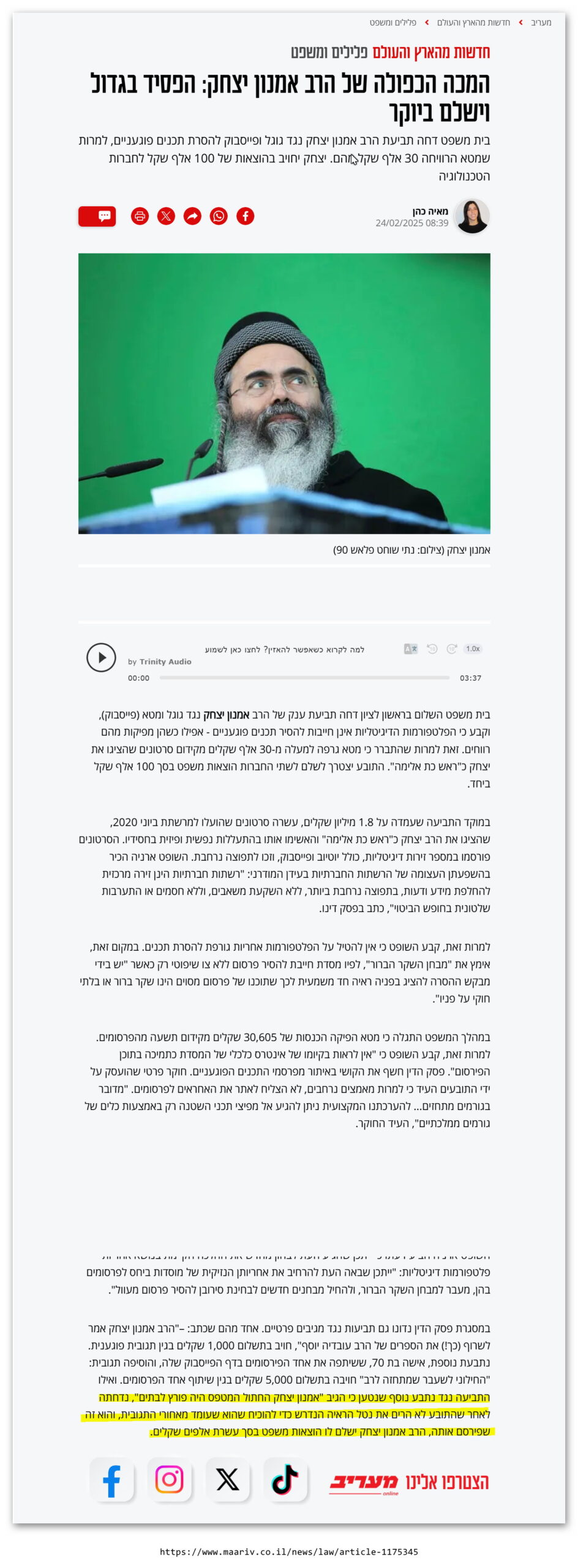
In this case, the applicant thought she would receive significant financial compensation for the failure to label products by the KSP chain, but in reality the approval request was rejected and she was charged 35,000 shekels in legal costs.