Filing an appeal with the assistance of attorney Eddie Blitstein
Filing an appeal by right (or by permission) is an action that requires great expertise. Attorney Eddie Blitstein has many years of experience in filing appeals correctly, and has actually led to the acceptance of many appeals.
As much as you need Professional legal assistance Regarding filing an appeal by right (or by permission), you are invited to contact Attorney Eddie Blitstein by phone.
What is a right appeal?
When we talk about an appeal right in the context of the Magistrate's Court or the District Court, we mean the right of a party (plaintiff or defendant) to argue before a higher judicial instance that the judgment given by the judge inCivil lawsuit or Financial claim Wrong in whole or in part.
In addition, a party who files an appeal of right against a judgment may, within the framework of the same proceedings, claim that one or more interim decisions rendered in the same proceedings were also incorrect and led to incorrect management of the legal proceedings (for example, a decision made by Request to annul a judgment in the absence of a defense or Request to attach evidence additional).
Any party may file an appeal. one You can then still try to dispute the ruling by filing a request for leave to appeal. Unlike filing an appeal on the merits, filing a Request for leave to appeal Requires approval from the higher court in order for the appeal to be heard on the merits once again.
How long does it take to file an appeal?
Previously, it was possible to file an appeal against a judgment within 45 days from the date it was presented to the party, but with the entry into force of The new Civil Procedure RegulationsAn appeal may be filed (as well as a request for leave to appeal) within 60 days from the date the judgment is served on the party (it may also be filed Counter-appeal Then the deadline will be 60 days from the date of the judgment)
The matter is stipulated in Regulation 137(a) of the Civil Procedure Regulations:
The deadline for filing an appeal against a decision is sixty days from the date it was made.
שימו להגדרת "ערעור":
Appeal or request for leave to appeal (in this chapter – appeal) The appeal will include two parts: a title and a body according to these instructions:

Where do I file an appeal?
Appeal of right against a judgment of Magistrate's Court Submitted to the district court.
An appeal of right against a judgment of the District Court is filed withSupreme Court.
What are the main differences between filing a lawsuit and filing an appeal?
The purpose of the proceedings and possible outcomes
Between claim management and management Appeal against a verdict There are a number of fundamental differences because these are proceedings with completely different purposes. While the purpose of a lawsuit is to prove that a litigant is entitled to some kind of relief (for example: monetary compensation, Order made, injunction, Foreclosure order etc.) The purpose of the appeal process is to convince the appellate court that the court that heard the claim erred and the result in the judgment is incorrect and unjust.
The result of accepting the appeal is either the case being returned to the court that heard it for the purpose of changing or amending the decision, or the appeals court will change the decision on its own initiative.
The documents that must be attached to the statement of claim and the notice of appeal
Regulation 134(3)(b) determines which documents must be attached to the notice of appeal:
(b) The appellant shall attach to the appeal only these documents:
(1) A copy of the decision being appealed;
(2) Copies of the documents on which the appellant seeks to rely that were duly filed and received in the previous instance.
That is, only the judgment or decision that is being appealed is attached to the notice of appeal, and in addition only documents that were submitted to the file of the court that issued the judgment.
Contrary to the notice of appeal, theClaim or Defense A litigant may attach the following documents:
15. (a) Only the following documents shall be attached to the statement of claims and shall be appendices to the statement of claims:
(1) A copy of a material document and any other document used as a basis for the claim in the statement of claims; if the document is not in his possession, it shall be indicated by whom or where it is located, to the best of the party's knowledge;
(2) An opinion of a medical expert that the litigant intends to rely on during the trial or a request for the appointment of an expert on behalf of the court pursuant to Section 108A of the Law;
(3) In a claim for compensation for personal injury, the plaintiff shall attach to the claim a waiver of medical confidentiality, drawn up in accordance with Form 1, 1A or 1B, as the case may be, in the First Appendix;
(4) In a claim for compensation for personal injury, the plaintiff or his attorney shall attach a declaration according to which he will attach to the statement of claim to be delivered to the defendant the documents listed in Sub-Regulations 15(a)?(3) and 17.
(b) Notwithstanding the provisions of subregulation (a), a party may attach to the pleadings an opinion of an expert who is not in a medical matter.
In fact, in accordance with these regulations, the litigant is permitted to attach almost any document he wishes to a statement of claim or statement of defense.
Fees and costs of filing a financial claim versus appealing a right?
For the purpose of filing a financial claim (excluding Class action lawsuit or small claim) the plaintiff must pay a court fee of 2.5% of the claim amount (half immediately upon filing the claim and half before The evidence discussion). This is a breakdown of the fees relevant to all proceedings in the Magistrate's Court:
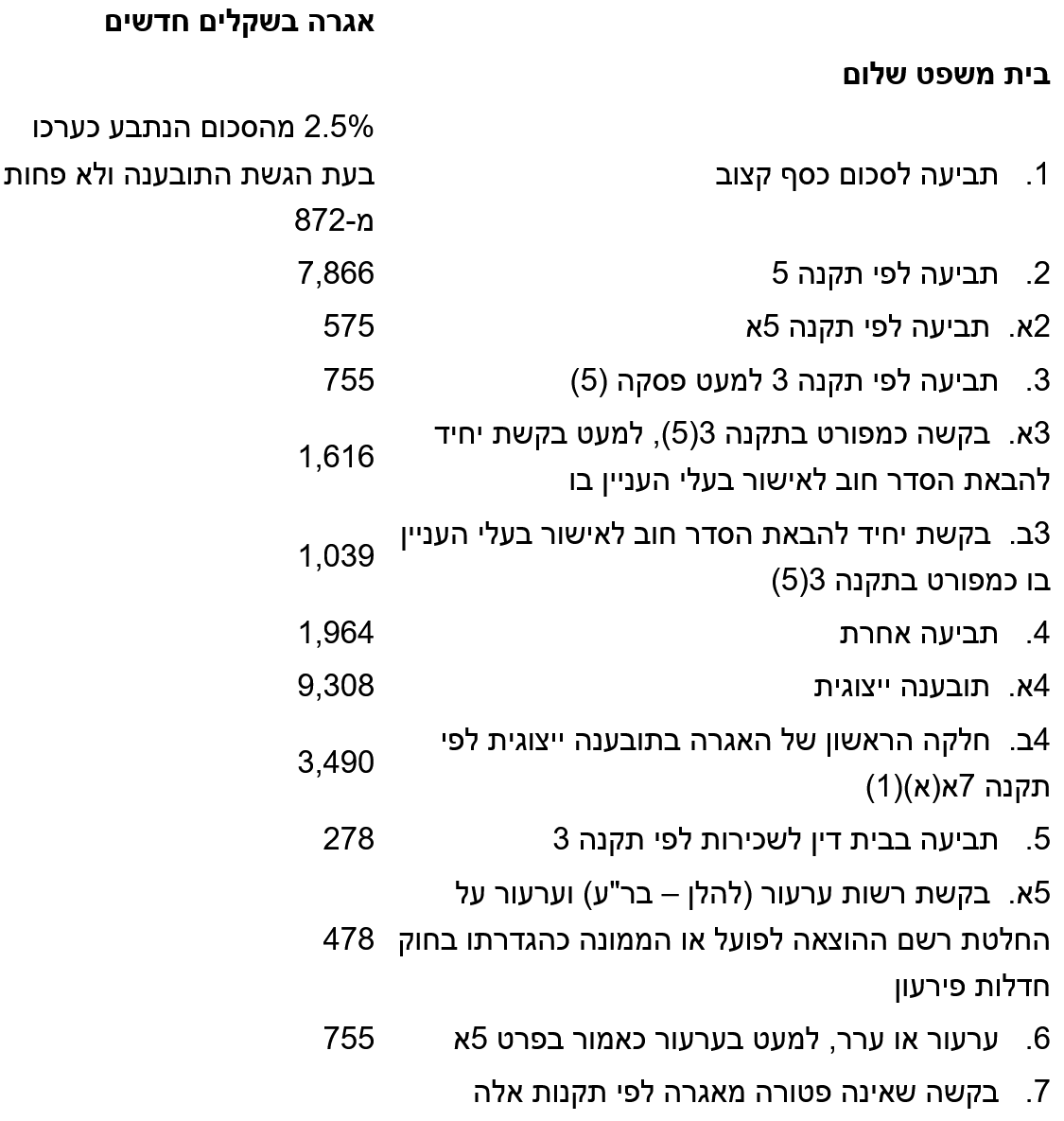
These are the fees in the district court:
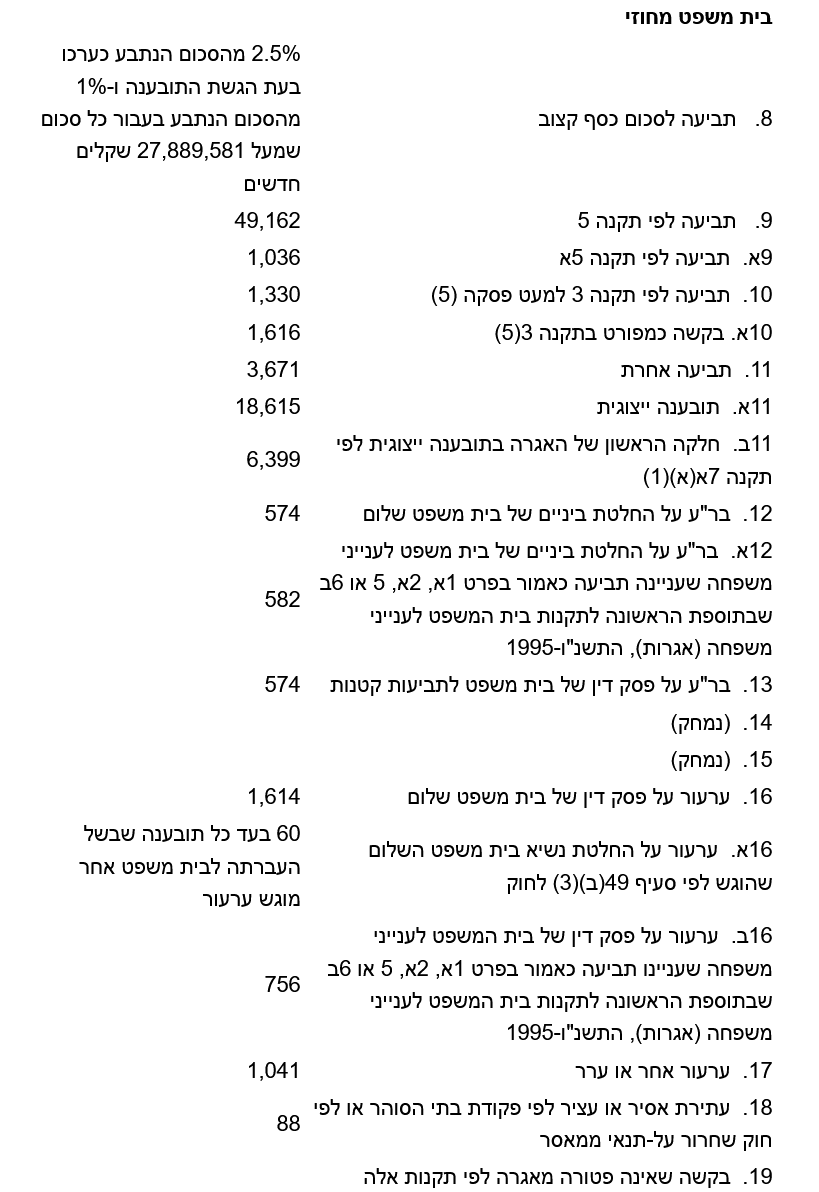
שימו לב שבפירוט האגרות הרלוונטיות לבית המשפט המחוזי ניתן למצוא את עלות הגשת ערעור בזכות על פסק הדין של בית משפט השלום, והסכום הוא 1614 ש"ח (הסכום מתעדכן מעט מדי שנה).
On the other hand, filing an appeal with the Supreme Court (against a district court ruling) A fee is charged. בסך 3454 ש"ח (הסכום מתעדכן מעט מדי שנה).
In an appeal proceeding, in addition to paying the fee, the appellant must post a bond to secure the respondent's expenses. These amounts vary depending on the type of proceeding and the court to which the appeal is filed.
These are the amounts relevant to the Supreme Court:
| Column A: Procedure type | Column B: Case type | Column C: Type of interest | Column D: Guarantee amount in new shekels |
|---|---|---|---|
| 1. Civil appeal | ע"א | Civil Appeal – General | 35,000 |
| 2. Civil appeal | ע"א | ערעור על פסק דין שניתן בתביעה לפיצויים בשל נזק גוף, לרבות תביעה שעילתה בחוק פיצויים לנפגעי תאונות דרכים, התשל"ה-1975, שהוגש בידי ניזוק בעניין גובה הנזק | 20,000 |
| 3. Civil appeal | ע"א | ערעור על החלטת פסלות לפי סעיף 77א לחוק בתי המשפט [נוסח משולב], התשמ"ד-1984 (להלן – חוק בתי המשפט) | 15,000 |
| 4. Civil appeal | ע"א | ערעור לפי חוק חדלות פירעון ושיקום כלכלי, התשע"ח-2018 (להלן – חוק חדלות פירעון ושיקום כלכלי) או לפי פקודת פשיטת הרגל [נוסח חדש], התש"ם-1980 (להלן – פקודת פשיטת הרגל) שהגיש חייב באותו הליך | 5,000 |
| 5. Civil appeal | ע"א | ערעור על החלטה לפי סעיף 77 לחוק העונשין, התשל"ז-1977 (להלן – חוק העונשין) | 7,500 |
These are the amounts relevant to the District Court:
| Procedure type | Bag type | Type of interest | Bail amount |
|---|---|---|---|
| 32. Civil Appeal | ע"א | Appeal heard before the panel against the decision of the Magistrate's Court | 20,000 |
| 33. Civil Appeal | ע"א | Appeal heard before a single judge against a decision of the Magistrate's Court | 15,000 |
| 34. Civil Appeal | ע"א | Appeal against a decision under Section 49 of the Courts Law | 7,500 |
| 35. Civil Appeal | ע"א | Appeal against a decision under Section 77 of the Penal Code | 7,500 |
| 36. Civil appeal | ע"א | Appealing a decision under the Domestic Violence Prevention Law | exemption |
| 37. Civil Appeal | ע"א | Appealing a decision under the Threatening Harassment Prevention Law | exemption |
| 38. Civil appeal | ע"א | Appeal against a decision under the Youth (Care and Supervision) Law | exemption |
| 39. Civil appeal | ע"ו | Appeal under the Families of Soldiers Who Died in Action (Compensations and Rehabilitation) Law or under the Disabled (Compensations and Rehabilitation) Law | exemption |
| 40. Civil appeal | ע"ו | Appeal under the Nazi War Disabled Persons Act or the Nazi Persecution Disabled Persons Act | exemption |
Submission of evidence
In the course of the prosecution, a party may submit his evidence at the time of filing a primary witness affidavit on his behalf or on behalf of his witnesses, or during a primary investigation as part of the evidentiary hearing. The matter is stipulated in Regulation 67:
The way to present evidence
67. (a) The court shall decide whether the main evidence will be heard orally or in writing; in its decision regarding the manner of hearing the evidence, the court shall consider, inter alia, the scope of the written and oral evidence, the complexity of the claim and the nature of the dispute between the parties, while giving priority to hearing oral evidence, if this will assist in discovering the truth and in the efficient conduct of the hearing.
(A1) If the court orders the submission of written primary testimony, and the party has not submitted a witness affidavit as aforesaid, the court may, without derogating from its other powers, order that the party shall not be permitted to bring the witness or prove the fact, unless the court is satisfied that the affidavit was not submitted for justified reasons.
In contrast to the trial court, where the litigant may decide which documents/evidence to submit to prove his claims, when conducting an appeal on his own motion, the litigant may submit new evidence only if he has received the court's permission to do so. The matter is stipulated in Regulation 144:
144. A party may not submit new evidence to the court of appeal; however, the court may permit the submission of new evidence if it is satisfied that it may affect the outcome of the appeal and that one of the following applies:
(1) It was not possible to locate the evidence with reasonable diligence and present it in the first instance at the appropriate time;
(2) The submission of evidence is necessary to prevent a miscarriage of justice.
Hearing witnesses
When conducting a lawsuit, the parties (the plaintiff or the defendant) may call any witnesses they deem appropriate to prove their claims. The court will hear the witnesses and be impressed by their credibility and/or the evidence they present.
In contrast, the appellate court hears witnesses again only in exceptional and rare cases. Most often, the appellate court will rely on the minutes of the hearing or the conclusions of the court that issued the verdict, in all matters relating to the credibility of the witnesses.

In conclusion
Appeal by right This is the right of a party to dispute the judgment given in the lawsuit. Each party may file one appeal. If the party wishes to file more than one appeal a second time, he will have to file a request for leave to appeal and first obtain leave to appeal. If leave is not granted, the request will be rejected.
An appeal of right may be filed within 60 days from the date the judgment was sent and received by the litigant.
The appeal is filed with the higher court. An appeal from the Magistrate's Court is filed with the District Court, and an appeal from the District Court is filed with the Supreme Court.
There are differences between handling a claim and handling an appeal, and not everything that can be filed or performed within the context of the claim itself can be filed or performed within the context of an appeal process.