Obtaining adequate compensation in court is not always a simple task, and contrary to popular belief among non-lawyers, the judge will not always award adequate compensation to the plaintiff. Conducting a lawsuit, obtaining a verdict in favor of the plaintiff, and receiving adequate financial compensation as part of the verdict is a long and complex process that requires extensive legal knowledge.
What are you trying to get adequate compensation for in court?
One of the first things to think about before submitting Financial claim The court is asking what I want to receive financial compensation for?
Receiving adequate compensation for financial damage
As you probably know, not everyone who submits Claim, wins the lawsuit and receives financial compensation. There are many cases in which the plaintiff loses his lawsuit and is even forced to pay legal costs to the defendant. To avoid losing in court, the claim must be substantiated with appropriate evidence, and it is not enough to file a claim and make any claims, because if the defendant denies those claims (as is usually the case), the judge will not be able to determine that the plaintiff has proven his claim, and will not be able to award him significant compensation.
For this reason, the plaintiff must prove his claim with appropriate evidence or witnesses who can support his claims. For example: When the claim concerns non-repayment Loan or requirement Damages for breach of contract, must prove to the court that the defendant actually received the funds or Breached the contractFor this purpose, a loan agreement can be shown and its certification that the funds were indeed transferred to the defendant. Without presenting this data, it will be difficult to win the lawsuit and receive adequate compensation.
The question arises whether in such a case, significant compensation will only be the repayment of the money given as a loan? The answer to this is usually no. In most cases, the court will also order additional financial compensation for the breach of the agreement (in addition to the reimbursement of legal costs and attorney's fees). The amount of additional financial compensation that will be awarded by the judge hearing the claim depends on many parameters, for example: whether the claim was concluded at an early stage with a settlement agreement or a verdict, how the defendant conducted himself throughout the claim and whether he made it difficult to investigate, what was the amount of the loan, whether the plaintiff suffered any damages for not repaying the loan on time, and many other parameters.
חשוב להבין כלל אצבע פשוט – פיצוי הולם בגין אי החזר הלוואה בסך 10,000 ש"ח (לדוגמה), לא יגיע כמעט לעולם ל-100,000 ש"ח (אלא אם כן ישנן נסיבות חריגות ומאוד מאוד קיצוניות). תמיד תהיה פרופורציה בין הנזק לגובה פיצוי ההולם שניתן לקבל בבית המשפט.

Receiving adequate compensation for emotional distress
תחילה, חשוב להבין שהמונח "עוגמת נפש" אינו שם קוד לפיצוי כספי אינסופי. בפרקטיקה ניתן למצוא מקרים רבים בהם עורכי דין מגישים Claims for emotional distress In absurd amounts, even when the amount of financial damage is very low. You will not find many cases in practice where the courts have accepted these claims and awarded the full financial compensation required for emotional distress.
לרוב, פיצוי הולם בגין עוגמת נפש יהיה תמיד נמוך יותר מסכום הפיצוי בגין נזק שניתן לכמת. השימוש בתביעות בגין עוגמת נפש שמור, בדרך כלל, לאותם מקרים בהם לא ניתן להוכיח או להציג נזק שאותו כן ניתן לכמת בכסף, או לאותם מקרים בהם "עוגמת נפש" נתבעת כראש נזק נוסף, אך לא העיקרי. עוגמת נפש תמיד נפסקת על דרך האומדנה, משום שהשופט לא באמת יודע מהי עוגמת הנפש "האמיתית" שנגרמה לתובע.
Receiving adequate compensation when proving damage requires an expert opinion
There are cases where it is not possible to receive significant compensation (or any compensation) if the court is not proven to have any expertise. It should be remembered that the judge is an expert in legal matters, but he is not an expert in medical matters, computer matters, automotive issues, etc.
In order to prove a matter that requires expertise, one must submit it to the court. Expert opinionAs part of the expert opinion, the expert explains to the court exactly what he examined, how he examined it, and what conclusions he reached.
For example: In a lawsuit involving medical damages, the expert may be a senior physician who examined the plaintiff (the patient) and concluded that, as a result of the defendant's negligence, the plaintiff suffered medical damages that prevent him from working. In such a case, appropriate compensation may be an amount of money that takes into account the plaintiff's age, how much time he has left to work until retirement, how much he earned before the event that prevents him from continuing to work occurred, etc.
In these issues, an expert opinion is necessary in order to receive significant compensation. Without an expert opinion, it is possible that not only will significant compensation not be awarded, but that compensation will not be awarded at all.
Adequate compensation based on similar cases previously decided in court
Today, it is very difficult to reach court with a unique claim – a claim that deals with an issue that the courts have not previously ruled on. Before a ruling is given in the framework of Civil lawsuit The parties refer the judge to rulings that support their claims. Each party details to the judge rulings that dealt with similar cases in which monetary compensation was awarded. Naturally, the plaintiff will always present rulings in which high compensation was awarded and the defendant will present rulings in which the claims were dismissed or in which low compensation was awarded. Each party will argue that the examples it presented indicate an appropriate amount of compensation that should be awarded in the case at hand.
The judge hearing the case will have to refer to those rulings. It will be very difficult to award very high monetary compensation in a lawsuit if many other very similar cases have awarded a low monetary amount for the same wrong/damage. If a judge does award very high monetary compensation in that case, the defendant will be able to appeal and claim that the amount of compensation significantly exceeds what is customary in similar cases, and that it is not an amount that is appropriate compensation for a case with the same circumstances.
The court to which the claim is filed affects the amount of appropriate compensation.
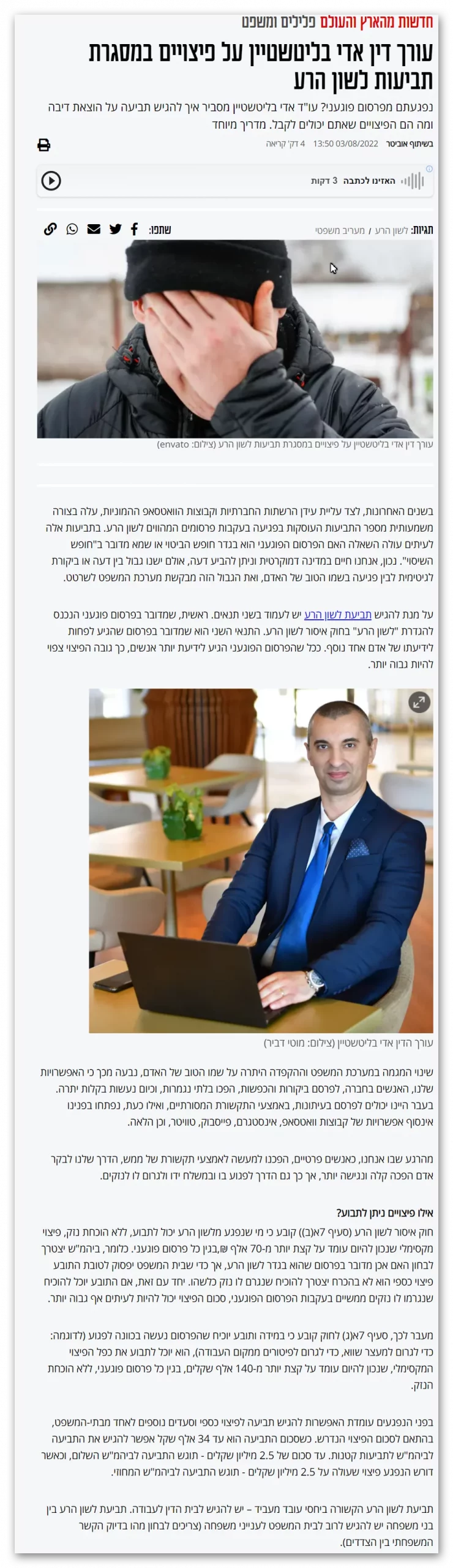
יש הבדל מאוד משמעותי בגובה הפיצוי שניתן לקבל בבתי המשפט השונים. לדוגמה גובה הפיצוי המקסימלי שניתן לתבוע כיום בבית משפט לתביעות קטנות עומד על כ-37.5 אלף ש"ח (הסכום מתעדכן מעט מדי שנה). יתכן שמלכתחילה אתם סבורים שיש לפסוק לטובתכם פיצוי הולם בסכום גבוה יותר, ולכן מראש אין טעם להגיש תביעה לבית משפט לתביעות קטנות.
Another important detail to consider is that in small claims court you can receive negligible monetary compensation for emotional distress (usually between hundreds of shekels to a few thousand shekels, in extreme cases). In claims for more significant damages, you can receive more significant compensation if you file your claim To the Magistrate's Court.
If you think you deserve adequate compensation exceeding 2.5 million shekels, you should file the claim with the District Court. You should always take into account that the amount of compensation you want to receive is not necessarily the amount of compensation that the court will award at the end of the proceedings, but there are also cases in which the court awards financial compensation in the amount of hundreds of millions of shekels.
In conclusion
In order to receive adequate compensation in court, it is not enough to file a lawsuit and rely solely on what is written in it. In order to receive the lawsuit and award compensation, prove to the court that the alleged events occurred, and that damage was indeed caused to the plaintiff. Must Support your claim with appropriate evidence or witnesses to support your claims.
In cases where a certain expertise is necessary, an expert opinion must be submitted to the court, otherwise, without it, not only will you not receive adequate compensation, but you may not receive compensation at all, and the lawsuit Reject.
לא ניתן להסתמך על צמד המילים "עוגמת נפש" כדי לקבל פיצוי כספי משמעותי (למעט מקרים חריגים).
It is always advisable to consult with Claims lawyer Financial before going to court to examine what might be appropriate compensation in the case relevant to you, and how to properly prepare for the lawsuit and what data to collect in order to be successful in it.
Frequently asked questions about receiving adequate compensation in court
-
How do you increase the chances of receiving adequate compensation in court?
It is very important not to rush and submit. Claim Unfounded or a claim that is not supported by appropriate evidence.
Careful preparation and collection of all possible evidence will significantly increase the chances that you will receive significant and appropriate compensation in court. -
I did not receive adequate compensation in court. What can I do?
The judge who hears the case and gives a verdict is not always right. In those cases where you believe that you have been wronged, it is worth considering Filing an appeal.
It is important to know that filing an appeal does not guarantee receiving higher financial compensation. The appeal can also be rejected and the appeal court can impose a fine on you. Legal expenses Significant. -
Is there a difference between receiving adequate compensation in small claims court and in the Magistrate's Court?
Magistrate's Court And small claims court are completely different judicial bodies that can award compensation in completely different amounts. While in small claims court you can receive a maximum of just over 34 thousand shekels, in the Magistrate's Court you can receive a maximum of 2.5 million shekels. Clearly, there is a significant difference between these amounts.
-
A court has ruled in my favor for adequate compensation. How soon should I receive the money?
The defendant is supposed to pay the financial compensation awarded in the judgment within 30 days. If the defendant does not pay, you can contact the Enforcement Office and begin enforcement proceedings.