What is an expert opinion?
An expert opinion submitted to a court is a document prepared by a person with expertise in his field in order to support some claim of the litigant that requires expertise. For example: An expert opinion can be submitted to prove medical damages and their consequences (a matter that may affect the amount of financial compensation). An expert opinion can be submitted to prove damage to the pipeline. An expert opinion can be submitted to prove how a cell phone works, etc.
ניתן לומר שכמעט בכל מחלוקת בין בעלי דין הרלוונטית לסוגיה שמצריכה מומחיות, יהיה צורך להגיש חוות דעת לבית המשפט. אין צורך להגיש חוות דעת בעניין החוקים במדינת ישראל משום שהשופט הוא "מומחה" לדין הישראלי.
Sometimes situations arise in which only one of the parties submits an expert opinion. In these circumstances, the court will usually favor that party's version, unless the party who did not submit an opinion succeeds in refuting what is stated in the expert opinion of the opposing party.

What should an expert opinion look like?
A common mistake is submitting an opinion using depositionAn expert does not submit his opinion by means of an affidavit except according to the wording prescribed in the Evidence Ordinance.
Article 20 To the Evidence Ordinance It states as follows:
The court may, if it sees no concern for a miscarriage of justice, accept as evidence, in writing, the opinion of an expert on a question in science, research, art or professional knowledge (hereinafter – opinion), and a doctor's certificate on the state of a person's health (hereinafter – doctor's certificate).
The wording of an expert opinion is detailed in the first appendix to the Evidence Ordinance:
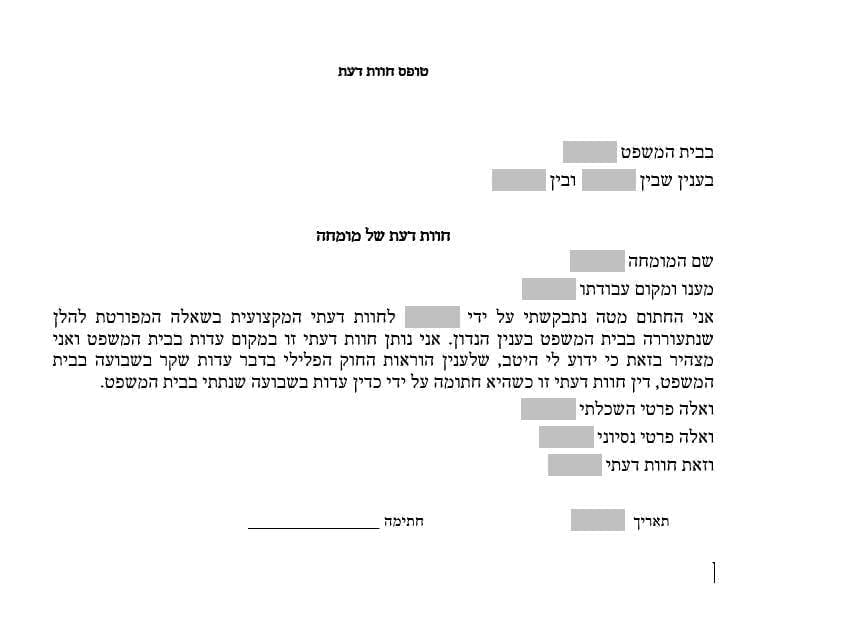
What is allowed and prohibited to include in an expert opinion (and what is the sanction)?
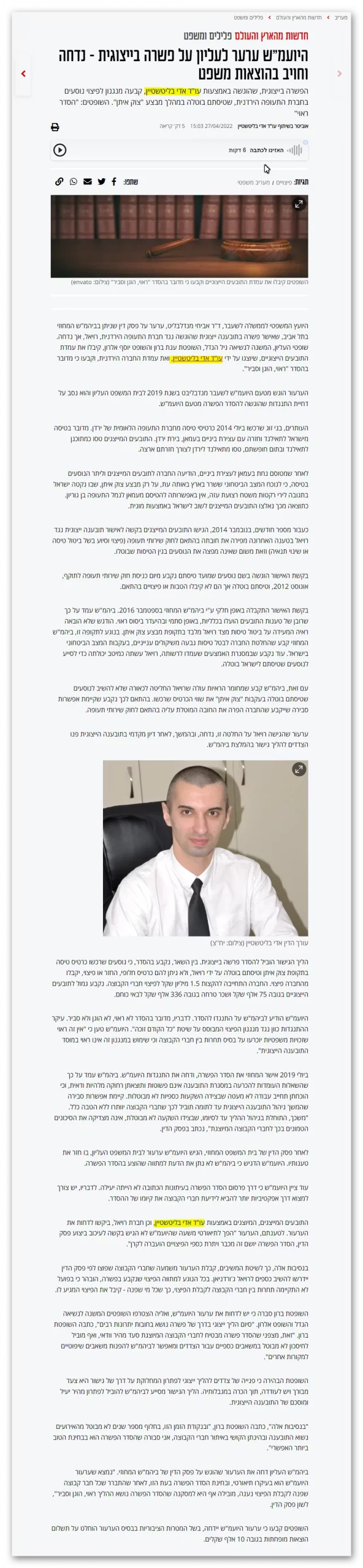
לאחרונה התייחס בית המשפט לסוגיה זו בת"א 41389-07-18 Facebook Ince נ' בן ציון גופשטיין (החלטה מיום 24.4.2022), וקבע, בין היתר, כך:
מצב בו מתברר לכתחילה שאותו מסמך שהוצג איננו כזו "חוות דעת מומחה", הרי שלא ניתן להגישו כלל, ולבית המשפט הסמכות להורות על החרגתו מכלל הראיות. כך ביחס למסמך בכללותו וכך ביחס לחלקים הימנו. מקום שנמצא כי חלקים מאותו מסמך, אותה חוות דעת, אינם כאלו שניתן להגיש בחוות דעת (למשל: מסקנות בעניינים משפטיים), מוסמך בית המשפט למחוק את אותם הקטעים מחוות הדעת על נספחיה. אם מוסמך בית המשפט להורות על סילוק חוות הדעת בכללותה, קל וחומר שבסמכותו לנקוט בסעד הפחות קיצוני של מחיקת חלקים הימנה.
…
According to the applicants, the appendices attached to the opinion were not disclosed by the respondent as part of the proceedings. Disclosure of documents, and therefore cannot be submitted. This claim is not clear. Those appendices were attached by the expert to the opinion he prepared. It is not claimed at all that these were provided to him by the respondent and in any case, as will be explained below, these are documents that are presented as the basis for the opinion and not those that are submitted as evidence of the truth of their contents. A party's obligation to disclose documents in his possession does not apply to such documents on which an expert on his behalf may rely. The applicants' claim to remove the appendices to the opinion on the grounds that they were not disclosed in the document disclosure proceedings is rejected.
…
It is important to remember the difference between presenting evidence to substantiate a factual claim, and presenting a factual foundation as the basis for an expert's opinion.
The possibility given to the litigants to support their claims with an expert opinion, one that is entirely conjecture, sharpens the distinction between expert testimony and ordinary testimony. While ordinary testimony is intended to present facts from which the court can later draw conclusions, in testimony that is an expert opinion there is no intention to establish the facts on which it is based, but only the conclusion drawn from them. An expert opinion is not a tool for establishing facts. A litigant who wishes to present facts that will serve as a foundation for proving his claims must do so in the proper way – by presenting evidence according to the laws of evidence.
…
And just to complete the picture, it should be emphasized that when we are dealing with a factual foundation on which the expert relies and which is presented from a second source, it is clear that the party on whose behalf the expert's testimony was submitted cannot also rely on the same factual foundation on which the expert relied, as if it were proof of any other factual claim. אותה תשתית עובדתית עליה מתבסס המומחה כוחה יפה אך ורק לביסוס מסקנותיו של המומחה, אך לא לביסוס טענות עובדתיות של בעל הדין. כדי שיוכל בעל דין להתבסס על העובדות שמביא המומחה בחוות דעתו, עליו להגישן כדרך בה מגישים כל ראיה "רגילה". לא ניתן לראות בחוות דעת מומחה אמצעי לעקיפת דיני הראיות וביסוס תשתית עובדתית בדרך עקיפה.
…
In light of all this, based on the legal principle that permits an expert to base his conclusions in his field of expertise for its own sake, he was also asked to provide an opinion on the basis that he brings from a second source and in derogation of the rule prohibiting the submission of hearsay testimony – the claim that the opinion or parts thereof should be deleted, and the claim that any appendices should be removed from the opinion due to their failure to be submitted according to the laws of evidence – is rejected.

Frequently Asked Questions
-
What is an expert opinion?
An expert opinion is a document prepared in accordance with the provisions of the Evidence Ordinance, which is submitted to the court file, and its purpose is to provide a professional opinion on a matter that is not within the court's expertise (not legal issues).
-
Is it possible to win a lawsuit without submitting an expert opinion?
Not every claim requires the submission of an opinion. An expert opinion should only be submitted when a question arises that requires a particular expertise. For example: medical issues, issues relevant to technology, etc.
-
What is the purpose of an expert opinion?
The purpose of an expert opinion is to explain to the court why the person on whose behalf the opinion was submitted is right, and sometimes how much damage was caused to him.
Because the court is an expert on legal issues but not on other issues, the judge hearing the lawsuit will not always be able to decide the lawsuit if some issue that requires expertise is not explained to him.For example: A judge will not be able to accept a claim for medical damages without an expert opinion that explains the medical damage caused to the plaintiff, and how the medical damage affects the victim's daily functioning. The more severe the damage to the victim according to the opinion, the more likely he or she will receive higher financial compensation.
-
What happens if only one party submits an expert opinion?
If only the plaintiff, for example, files an opinion but the defendant does not file a counter-opinion on his behalf, there is a higher likelihood that the court will accept the claim.
In the opposite situation, where the plaintiff does not submit an opinion but the defendant does submit an opinion supporting his claims, there is a higher likelihood that the court will dismiss the claim.