עם כניסתן לתוקף של תקנות סדר הדין האזרחי, תשע"ט – 2018 בתחילת שנת 2021 חל שינוי מהותי בפרוצדורה המשפטית שעל בעלי הדין לקיים Even before they arrive for a hearing before the court. One of these changes is the existence of a preliminary discussion between the parties.
What is a preliminary hearing and when should it be held?
A preliminary hearing and the relevant procedure are set forth in Regulations 34-36 of the Civil Procedure Regulations, which state as follows:
The purpose of the preliminary discussion
34. The parties will hold a preliminary hearing as specified in Regulation 35; The purpose of the preliminary hearing is to ensure that the parties are well prepared for the hearing of the claim and to clarify the dispute with mutual disclosure and full transparency between them, in a manner that will allow them to be adequately prepared for the hearing and to examine the possibility of resolving the dispute through an alternative mechanism for resolving the dispute..
35. (a) Within thirty days from the date of the filing of the last statement of claim, the parties shall conduct, Except for a party who is not represented by a lawyer, preliminary discussion, will respond to these matters, among others:
(1) The demarcation of the parties' companies, their focus, and the possibility of reducing them;
(2) the possibility of resolving the dispute through an alternative dispute resolution mechanism;
(3) If the parties decide that judicial proceedings cannot be avoided in the dispute between them, they will, at a minimum, examine the possibility of agreeing on the steps to be taken to reduce and streamline the legal proceedings as much as possible, including the preliminary submission of the subject of the opinion for examination by an expert on behalf of the opposing party or the appointment of an agreed expert.
(b) During the preliminary hearing, the parties will allow for review of the necessary documents and will answer each other's questions that need to be answered in order to resolve the differences and reduce the disputes between them, while acting with maximum transparency.
36. At the end of the preliminary hearing and no later than fourteen days before the date set for the first pre-trial meeting, the parties shall submit a report regarding the preliminary hearing they conducted, according to Form 4 in the First Appendix, and shall attach to it the necessary documents presented during the preliminary hearing and according to Regulation 35(b); in the absence of agreement on a joint report, each party shall submit the said form on his own behalf only.

הדיון המקדמי רלוונטי אך ורק להליכים המתקיימים לפי תקנות סדר הדין האזרחי, תשע"ט – 2018. כלומר, אין צורך לקיים דיון מקדמי כאשר הוגשה תביעה קטנה. יש צורך לקיים דיון מקדמי אם הוגשה Financial claim or Civil lawsuit In ordinary law or Quick justice.
A preliminary hearing is actually an attempt by the parties to simplify the procedure through deliberative agreements (as the parties reach these agreements). During the preliminary hearing stage, there is no judge involved and the parties do not even come to court.In practice, the preliminary discussion does not usually lead to a physical meeting between the parties, but rather takes place by telephone or other electronic means.
The purpose of the preliminary hearing is to reach a pre-trial hearing, which is held before a judge, when the parties are already well aware of the claims and/or documents in the opposing party's possession, all with the aim of being able to conduct legal proceedings without surprises (which may lead to the filing of numerous and unnecessary interim motions, thus complicating and delaying the proceedings).
The preliminary hearing must be held within 30 days of the filing of the last pleading. In practice, a preliminary hearing is not held within this time period, especially given the fact that the report on the results of the preliminary hearing must be submitted to the court up to 14 days before the pretrial hearing.
The report regarding the outcome of a preliminary hearing must be submitted to the court using Form 4, which looks like this:
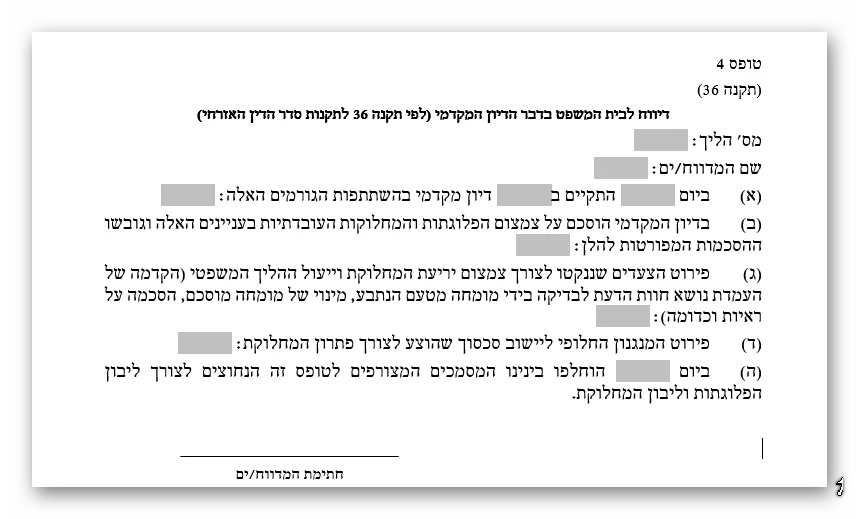
Sometimes there is no agreement between the parties regarding the submission of a joint report regarding the outcome of a preliminary hearing. In these circumstances, each party must submit a separate report.
A party who refuses to hold a preliminary hearing risks legal costs or, in extreme cases, even Deletion of his statement of claim, as stipulated in Regulation 38, which states as follows:
38. (a) The court may, in the pre-trial proceedings, order a party who has violated the provisions of regulations 35 to 37 to comply with them, unless it finds special reasons not to do so; if the plaintiff violates these provisions, the court may, without derogating from its other powers, suspend the proceedings until he complies with them as required. And even to dismiss the lawsuit for special reasons.
(b) The court is of the opinion that a party has not complied with the provisions of this chapter in whole or in part and there was no justifiable reason for his conduct, They will be ordered to pay costs immediately in favor of the opposing party or in favor of the State Treasury, and no later than the end of the last pre-trial meeting, even if he subsequently complied with the instructions, unless he finds special reasons not to do so.
(c) The court will decide the amount of expenses taking into account, among other things, the conduct of the party in the preliminary hearing and his good faith, including:
(1) did not disclose to the opposing party information that he was required to disclose;
(2) His activity in the proceedings was minimal compared to the complexity of the dispute between the parties or was not sincere;
(3) Did not act properly and as required of a fair lawyer.
What is a pretrial conference and how is it different from conducting a preliminary hearing?י?
First, it is important to understand that a preliminary hearing is not a pre-trial. These are different legal procedures with different purposes. A pre-trial is actually the first meeting of the parties with the judge hearing the case. During a pre-trial, the judge has many powers, which are set out in Regulation 63:
63. (a) As a general rule, it is appropriate for the court to strive for the pre-trial phase not to exceed two sessions in the Magistrate's Court and three sessions in the District Court.
(b) At the pre-trial hearing, the court shall order the methods of hearing the claim with the aim of streamlining, simplifying and expediting it; in particular, it may, on its own initiative or at the request of a party –
(1) To order the stages of the hearing of the claim and the dates for their holding;
(2) To order the manner and timing of the hearing Third-party notifications and counterclaims;
(3) to direct whether the main evidence will be heard orally or in writing as stated in Rule 67;
(4) To instruct on the manner of submission and the methods of hearing the listed applications. In the request list;
(5) To divide the discussion and give any deliberative instructions regarding the manner of resolving the disputes;
(6) To order the format of the proceedings, the duration of the proof of the claims and the validity of the evidence;
(7) To order the order of witnesses who will appear at the hearing or present documents and the duration of the interrogations, as well as to determine that the interrogation of a particular witness is unnecessary and not required;
(8) To order the hearing of preliminary testimony, testimony outside the courtroom or in visual conference, as well as Deposit of security deposit To secure the expenses of witnesses;
(9) To appoint an expert to investigate a dispute between the parties;
(10) To order the parties to submit a consolidated or separate file of exhibits that will include the exhibits of all parties;
(11) To order the addition and deletion of litigants;
(12) To order the amendment of the pleadings, the deletion of anything unnecessary to the matter, the clarification of the list of disputed questions, and the drafting of the pleadings;
(13) to give Temporary relief;
(14) To hear the testimony of everyone present in the courtroom, regarding the fact in dispute, and to receive answers to questions on matters relating to the dispute that is the subject of the action;
(15) To order the party to respond in an affidavit to various questions or matters;
(16) To strike out the statement of claim or dismiss the claim or grant verdict If he finds that the defense does not reveal any defense at all;
(17) Offer to the parties Compromise offer Or offer them a ruling on a compromise or alternative mechanism for resolving the conflict.
(c) Nothing in sub-regulations (a) or (b) shall derogate from the court's authority to make decisions concerning the conduct of the proceedings even before the pre-trial hearing.
(d) At the concluding pre-trial meeting, the court will order the procedures for hearing the claim, including ordering the dates for hearing the witnesses and summaries, and will set the duration of the testimony, the times of the interrogations, and the duration of the summaries for each of them.
As can be clearly seen, the powers of a judge in the pre-trial phase are very broad and their purpose is to simplify the procedure as much as possible, and even to end it in appropriate cases. To the extent that the parties do not reach a compromise, the court is authorized during the pre-trial phase to order the granting of temporary remedies (such as Order made or injunction or Temporary seizure), the court is authorized to order Correction of pleadings And even hearing the testimony of every person in the courtroom.

Frequently Asked Questions
-
What is the difference between a pretrial and a preliminary hearing?
A pre-trial is a hearing that takes place before the judge hearing the case. In contrast, a preliminary hearing is a procedure in which only the parties (and usually only the parties' attorneys) should hold a hearing with the aim of trying to reduce the disputes.
A party who is not represented by a lawyer is not required to hold a preliminary hearing but must attend a pretrial conference.
-
What happens if we don't make it to one of the discussions?
If you do not attend a hearing before a judge, the judge may dismiss the case. The statement of claim or give Judgment in default of appearance.
If the provisions of the regulations regarding the preliminary hearing are not complied with, the court may order legal costs to be paid by the opposing party or by the state treasury. -
Do I have to hire a lawyer to carry out the entire legal procedure?
You can go to court or carry out the preliminary procedures before going to court even without a lawyer, assuming you know what you are doing.
It is generally recommended to seek the services of an experienced lawyer to avoid causing significant damage in the management of the case. Repairing this damage may cost you dearly. -
Can the court give a verdict at the first hearing?
If the parties reach any compromise, the court may issue a ruling at the first hearing (a ruling confirming the compromise and the parties' agreements).
The court can give a verdict at the first hearing even if it turns out that the defense does not present any defense.
In the vast majority of cases, the courts will prefer to allow the defendant to defend himself and will avoid issuing a verdict at the first hearing.